Corrosion Surveys
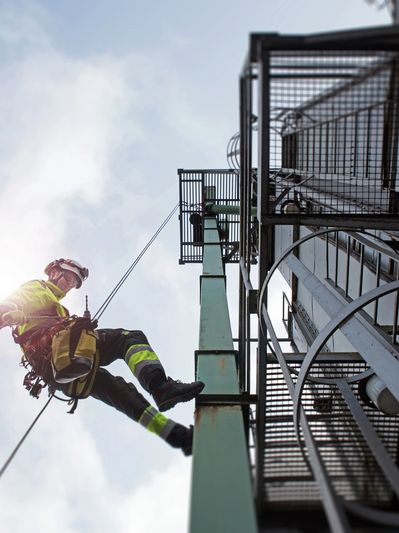
Rope Access Corrosion Survey (UT & RT)
TKMS provides advanced rope-access corrosion survey services using Ultrasonic Testing (UT) and Radiographic Testing (RT) to assess asset integrity in challenging and hard-to-reach environments across Canada and the United States. Our integrated NDT and rope access approach allows for efficient, low-impact inspections without the need for scaffolding or heavy access systems.
Our certified NDT technicians and SPRAT/IRATA-qualified rope access professionals work as a single, coordinated team to deliver accurate corrosion data while maintaining the highest safety and quality standards.
Our corrosion survey services include:
- Ultrasonic thickness measurements for corrosion mapping and remaining life assessment
- Radiographic testing (CR/DR or isotope-based) for internal corrosion, erosion, and weld condition evaluation
- Corrosion under insulation (CUI) inspections with targeted insulation removal and reinstatement
- At-height and confined-space inspections on vessels, piping, tanks, stacks, and structural components
- Baseline surveys, condition assessments, and follow-up inspections for asset integrity programs
All inspections are performed in accordance with applicable codes, standards, and client specifications, supported by rigorous QA/QC procedures, equipment calibration, radiation safety controls (where applicable), and comprehensive reporting. Inspection results are clearly documented, traceable, and suitable for engineering review, maintenance planning, and regulatory compliance.
By combining rope access efficiency with proven UT and RT methodologies, TKMS minimizes downtime, reduces access costs, and delivers reliable corrosion intelligence to support informed decision-making and long-term asset management.
Project Management
We handle all aspects of project management, from planning and budgeting to scheduling and quality control. Our team ensures that every project is completed on time and to the highest standards.
Scaffolding vs Rope Access — Safety & Cost Advantage
Rope access offers a clear advantage over traditional scaffolding for corrosion surveys and at-height inspections, delivering significant reductions in cost, schedule, and operational impact. By eliminating the need for engineered access structures, rope access minimizes mobilization time, reduces congestion in live process areas, and allows inspections to be completed faster with fewer resources.
From a safety perspective, the primary benefit is the substantial reduction in total human exposure hours. Scaffolding requires large crews, extended erection and dismantling periods, and prolonged work at height, all of which increase exposure to dropped objects, manual handling, and fall hazards. Rope access, by contrast, uses small, highly trained teams, rapid deployment, and short-duration work scopes, dramatically lowering exposure time while maintaining strict safety controls.
The result is a safer, more efficient inspection method that reduces downtime, lowers overall risk, and delivers high-quality inspection data without compromising regulatory compliance or asset integrity.